Table of contents
Engineering loves clean diagrams, crisp tolerances, and elegant assumptions, yet the shop floor has a way of humiliating all three. Over the past year, manufacturers have been forced to rethink “obvious” choices as energy prices stayed high, lead times swung unpredictably, and quality requirements tightened across sectors from transport to medical devices. The result is a quieter revolution: everyday fabrication constraints are reshaping what engineers consider best practice, and debunking long-lived myths that still circulate in design offices and procurement meetings.
Prototypes fail where drawings look perfect
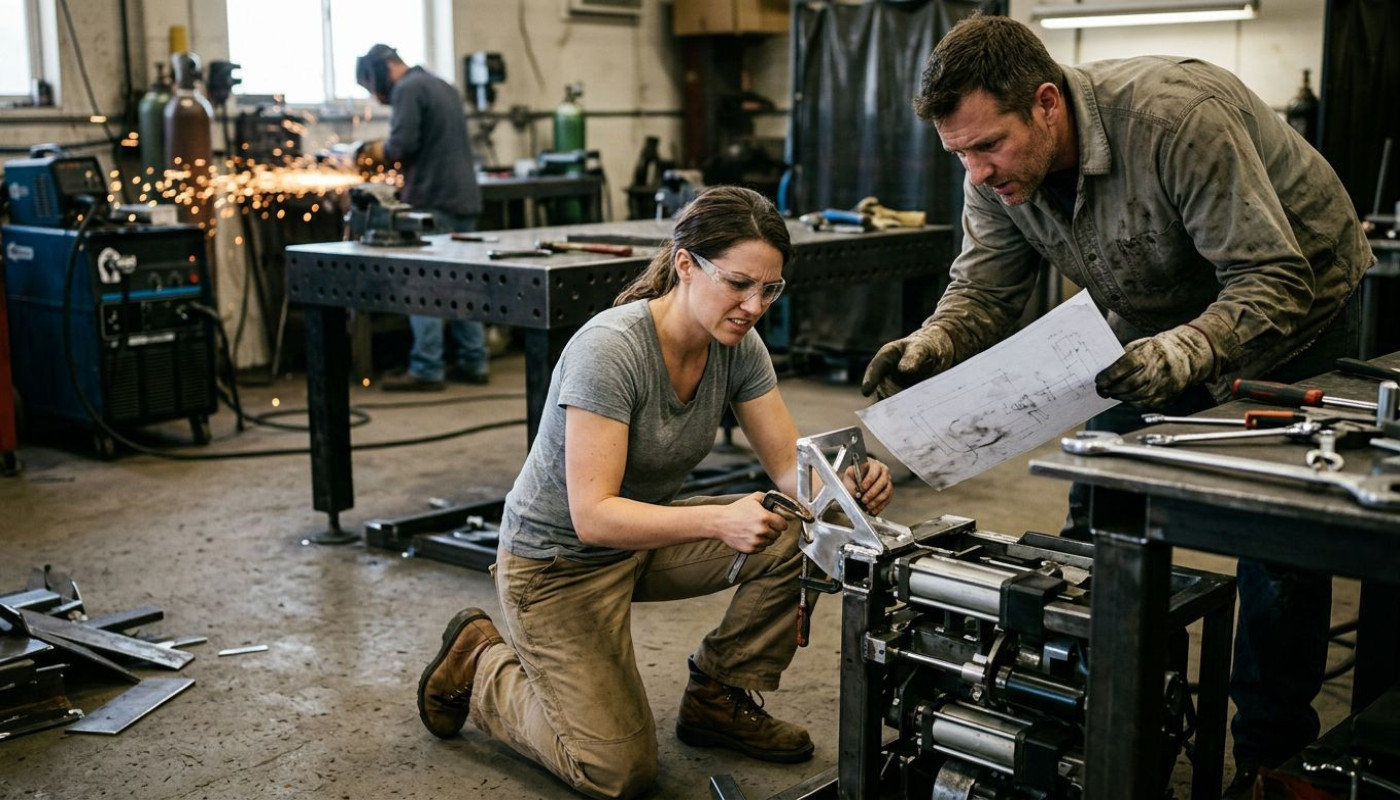
“If it works in CAD, it will work in metal” remains one of the most expensive beliefs in engineering, because the distance between a digital model and a production-ready part is measured in variability, and variability is where budgets go to die. On paper, tolerances stack neatly; in reality, they accumulate across cutting, bending, welding, heat, and assembly, and each step introduces its own scatter. Even when individual operations hit spec, the combined effect can push an assembly out of functional range, and the pain only shows up at integration: fasteners that bind, connectors that misalign, doors that rattle, and cable paths that violate minimum bend radius. The myth collapses the moment a prototype meets its first real-world constraint: how a technician can actually reach a screw, route a harness, or replace a component without disassembling half the system.
Data from industrial quality programs underline the point, even if they are rarely quoted outside operations teams. In many plants, rework and scrap routinely account for a low single-digit share of sales, but that “small” percentage becomes enormous on high-volume lines; industry benchmarks frequently place the total cost of poor quality in the range of several percent of revenue once inspection, rework labor, and warranty exposure are counted. The lesson for design is blunt: buildability is not an afterthought, it is a requirement that must be engineered in. That means designing with measurement capability in mind, choosing datum schemes that match how parts are actually fixtured, and validating critical features with process capability rather than a one-off prototype that happens to pass on a good day.
Fabrication teams increasingly push for early “process-informed” reviews, because many late-stage surprises are predictable. A bend relief that looks fine can tear on the press brake if grain direction is wrong, a welded frame can pull out of square as heat distributes unevenly, and a perfectly dimensioned panel can become a nightmare once paint thickness and masking lines are added. The most effective organizations treat prototype feedback as empirical evidence, not as an inconvenience, and they loop it back into the next iteration with the same seriousness as a simulation result.
Lead time beats unit price, repeatedly
Procurement spreadsheets still reward the lowest line item, yet real manufacturing is a race against downtime, and downtime rarely cares about your negotiated discount. A delayed enclosure, a missing electromechanical subassembly, or a late harness can stop integration, push testing, and force teams into costly expediting, and once a schedule slips, the “savings” evaporate into overtime, premium freight, and rescheduled customer deliveries. This is why many operations managers have grown more skeptical of offshore quotes that look unbeatable, especially when they come with uncertainty about capacity, documentation standards, or the ability to respond quickly to engineering changes.
The underlying myth is that procurement is a purely financial optimization; in practice, it is a risk management discipline, and the best buyers quantify risk in days, not only in euros. Shortening lead time often means simplifying designs, standardizing parts, and choosing suppliers who can control key processes in-house. In electromechanical manufacturing, that can include machining, sheet metal, wiring, and final assembly under one quality system, because each handoff adds delay potential, and each delay multiplies when several sub-suppliers are involved. The most resilient supply chains are the ones that can answer a change request without a three-week email chain, and deliver a revised part without resetting the entire timeline.
This is where an industrial partner’s scope matters more than marketing claims. Organizations that source enclosures, cabinets, and integrated electromechanical assemblies increasingly look for a supplier who understands both the mechanical constraints and the wiring realities, and who can document what has been built so the next batch is repeatable. For readers comparing manufacturing approaches, the profile of an Aventech Industrial electromechanical manufacturer illustrates the kind of integrated capability that reduces schedule risk: when fabrication and assembly knowledge sit close to engineering, design changes can be evaluated against real process limits, and the most time-consuming surprises are addressed earlier.
“Just tighten tolerances” is not quality
When a product fails a fit test, the reflex in some teams is to tighten tolerances, because it feels like precision equals performance. The shop floor reality is harsher: tighter tolerances can reduce yield, drive up inspection time, and increase cost without improving functional outcome, particularly if the process is not capable of holding the new limits consistently. What looks like a simple drawing change can trigger new tooling, more frequent calibration, additional in-process checks, or outright process substitution, and each of those levers has a cost that may dwarf the original issue. Quality is not an aesthetic preference for small numbers; it is a controlled relationship between function, process capability, and verification method.
Capability metrics make this concrete. Many manufacturers use statistical process control to evaluate whether a process can hold a given tolerance band; if it cannot, the correct response is not always to squeeze harder, but to redesign the feature so it is easier to make consistently, or to change the process. A hole pattern that demands extreme positional accuracy might be better served by using slots, floating nuts, or self-locating features; a mating interface might be improved by adding compliance, and a seal might perform better with controlled compression than with ever-tighter flatness. In short, functional tolerancing beats “tight for tight’s sake”, and the best engineering teams write drawings that reflect how parts will be measured, not how they look in a rendering.
Everyday fabrication adds additional layers that are often ignored in early design: coating thickness, powder cure shrinkage, edge rounding, burr direction, and even operator ergonomics. A cabinet that meets dimensional spec before finishing can fail a door closure test after powder coating, and a connector that fits in a 3D model can become inaccessible once a cable gland and strain relief are installed. These are not exotic corner cases; they are predictable interactions between real processes, and they explain why experienced fabricators insist on design-for-manufacture reviews that include finishing, assembly sequencing, and service access. Quality emerges when the entire chain is engineered as a system, and not when one number on a drawing gets smaller.
Automation helps, but humans close gaps
Factories have invested heavily in automation for good reasons: consistency, throughput, traceability, and safer handling of repetitive tasks. The myth is that automation eliminates variability, when in fact it often relocates it. A CNC machine can cut the same profile all day, yet fixture wear, tool life, thermal drift, and material lot differences still matter, and a robot can place a weld with excellent repeatability while the assembly still distorts because heat input is physics, not software. Automation is a force multiplier, but it demands disciplined process control, robust maintenance, and clear feedback loops, otherwise the line produces defects faster than humans ever could.
Daily production also reveals where humans remain indispensable, and not only for “manual” tasks. Technicians detect anomalies that dashboards miss: a slightly different sound during fastening, a cable that wants to twist the wrong way, a door that closes but doesn’t feel right, a paint edge that suggests contamination, and an assembly sequence that will be painful for service teams months later. Those observations, when captured properly, become operational intelligence. Many manufacturers now formalize this with layered process audits, first-article inspections tied to real measurements, and structured non-conformance workflows that turn shop-floor feedback into design changes rather than blame.
The most effective plants blend automation with human-centered production engineering. They standardize work, invest in jigs and fixtures that reduce dependence on individual technique, and train operators to understand not only “how” but “why”. They also design assemblies so that mistakes are hard to make: keyed connectors, asymmetric features, and clear labeling that survives the entire lifecycle. In electromechanical fabrication, where mechanical tolerances meet wiring discipline, this hybrid approach is often the difference between a cabinet that passes tests once and an assembly that passes every time, across shifts, batches, and customer environments.
Practical next steps for engineering teams
Turning these myths into better outcomes does not require a grand transformation, but it does require earlier realism. Reserve time for a buildability review before drawings are frozen, budget for at least one iteration informed by measurements rather than opinions, and ask suppliers for concrete evidence of process control: inspection plans, traceability practices, and examples of how engineering changes are handled. If schedule risk is high, prioritize partners who can shorten the feedback loop between fabrication and assembly, and who can support documentation that keeps batches consistent.
Cost discipline still matters, but treat it as total cost: include expediting, rework, inspection load, and the opportunity cost of delayed testing. When planning, set aside contingency for prototypes, fixtures, and finishing trials, and check whether local or regional programs offer support for industrial modernization, energy efficiency, or training, because those aids can change the economics of a project. Above all, plan the build like a product, not like a drawing.
Similar

How Tourism Boards Use Wechat To Rewrite Destination Storytelling

Under The Hood: How Ai Changes The Logic Of Software Comparison

Maximizing Academic Performance With AI-driven Study Assistants

Can AI Enhance Understanding Without Encouraging Cheating?

Exploring The Impact Of Free AI Models On Creative Industries

How To Leverage Social Media For Enhancing Your Website's Reach?

How To Optimize Cluster Performance Post-Kubernetes Upgrade?

Enhancing Workplace Productivity With A Mobile Booster For Office Environments

How Cloud Computing Is Revolutionizing Software Construction?

How AI-Powered Tools Are Revolutionizing Personal Photo Editing

How Secure, Ad-Free File Transfer Solutions Enhance User Experience

Understanding the impact of quantum computing on encryption and data security

How To Choose The Right Free Software For Nonprofit Management

Comparing Different Patch Management Tools For Linux Servers

Programmatic Advertising And AI Image Generation: A Perfect Match?

How Swiss Innovation Is Shaping Web and App Development

The Impact Of All-in-One Dashboards On Interdepartmental Collaboration

ChatGPT: The Next Big Thing in AI Technology

Understanding the Mechanisms Behind Anti-DDoS Programs

The Future of Customer Service: How Chatbots are Changing the Game

Unveiling Quantum Computing: A New Frontier
